HiddenLayer is a strong choice for model and AI supply chain protection. Zenity and Noma Security stand out for enterprise agent governance. WitnessAI suits organizations protecting employee AI usage and application interactions.
Lasso Security, Harmonic Security and Mindgard include runtime protection of data, data exposure and adversarial testing.
AI security platforms protect AI models, agents, and data against various threats such as prompt injection, data leakage, and model theft. These AI security tools aid organizations to safeguard systems during development and production.
How We Picked and Evaluated These Platforms
We have chosen vendors according to availability of products, capabilities of the enterprise, model protection, availability of agents, integrations, and deployment flexibility. We have checked official product documents, technical pages and accessible product demonstrations.
No private trials or independent attack tests were conducted. Therefore, each review uses a documentation-based evaluation rather than claiming first-hand testing.
Comparison: 7 Best AI Security Platforms for Enterprise Teams
| Platform | Best For | Key Feature | Pricing Model | Integrations | Deployment | AI Agents |
| HiddenLayer | Model security | Model scanning and runtime defense | Custom | CI/CD, SIEM/SOAR, MLOps | Custom | Yes |
| Zenity | Agent governance | Runtime agent boundaries | Custom | Microsoft, Salesforce, AWS, Google | Custom | Yes |
| Noma Security | Agent control | Context-based action enforcement | Custom | AWS, Azure, Salesforce, SaaS | Custom | Yes |
| WitnessAI | Enterprise AI protection | Intent-based inspection | Custom | Proxy, API, MCP | Custom | Yes |
| Lasso Security | Agent protection | AI red teaming and runtime enforcement | Custom | AWS, Vertex AI, Salesforce, CI/CD | Custom | Yes |
| Harmonic Security | AI data security platform | Contextual data controls and MCP gateway | Custom | Intune, Jamf, Kandji, MCP | SaaS and endpoint | Yes |
| Mindgard | AI vulnerability testing | Attacker-led reconnaissance | Custom | APIs, CI/CD, Burp Suite | Custom | Yes |
Custom indicates that public starting prices or complete deployment specifications were not confirmed. Buyers should request vendor documentation.
7 Best AI Security Tools for Enterprise Teams
1. HiddenLayer: Best for AI Model and Supply Chain Security
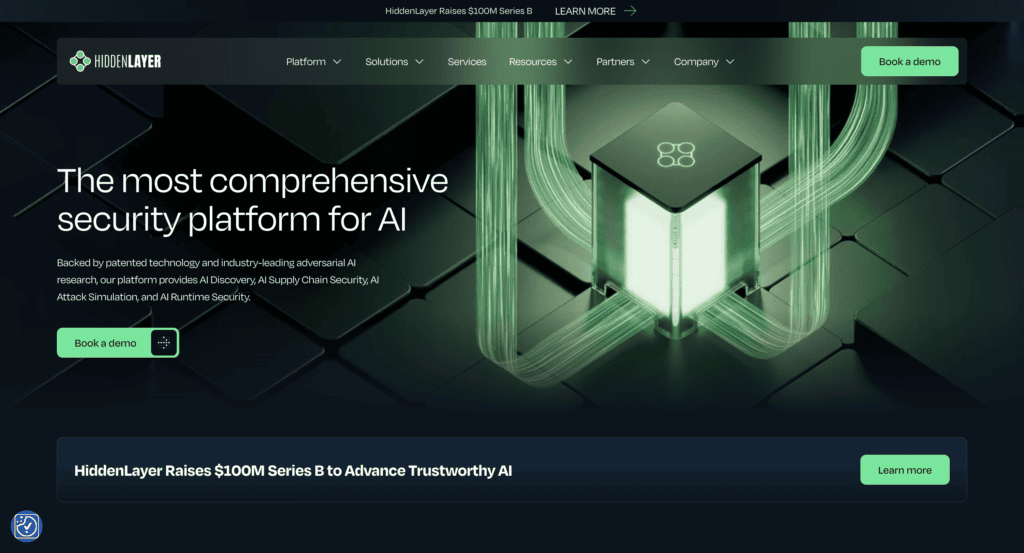
Overview: HiddenLayer protects predictive, generative and agentic AI applications. Its platform covers AI discovery, model supply chain security, attack simulation and runtime protection.
Organizations building their own AI infrastructure should also consider the hardware requirements involved in model development and deployment. Our guide to AI servers for business compares enterprise options for AI training, inference and large-scale workloads.
How we evaluated it: We reviewed HiddenLayer’s official platform and supply chain documentation. Its model scanning looks at model architecture, weights and model artifacts as well as potential tampering during pre-deployment.
Pros:
- Proprietary, third-party and open-source scans.
- Detects risky model changes and supply chain risks.
- Offers runtime defense against immediate attacks and information leaks.
Cons:
- Public pricing is unavailable.
- Additional controls might be needed in businesses where workforce AI governance is needed.
Pricing: Custom enterprise pricing, verified November 4, 2026.
Official source: https://www.hiddenlayer.com/platform
2. Zenity: Best for Enterprise AI Agent Governance
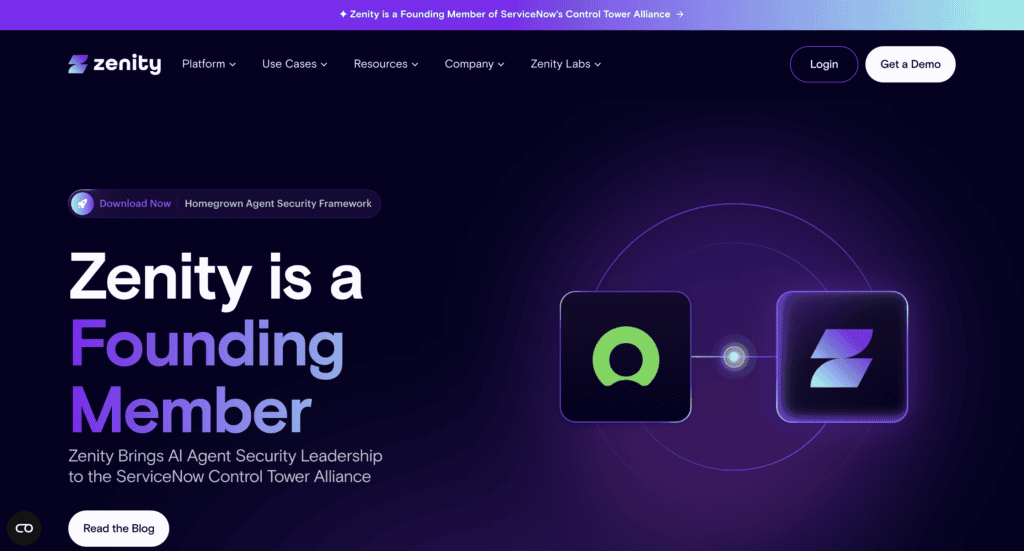
Overview: Zenity secures AI agents across SaaS, cloud and custom environments. Its platform evaluates agent configurations, permissions and actions to prevent unauthorised activity.
How we evaluated it: We examined Zenity’s official platform documentation and supported ecosystem. The product specifically covers Microsoft Copilot Studio, Salesforce Agentforce and cloud-based agents.
Pros:
- Inventories agents across enterprise environments.
- Evaluates agent permissions and configurations.
- Enforces policies when agents attempt actions.
Cons:
- Pricing requires direct vendor engagement.
- Organisations should validate integration coverage for custom-built agents.
Pricing: Custom enterprise pricing, verified November 4, 2026.
Official source: https://zenity.io/platform
3. Noma Security: Best for Runtime Agent Control
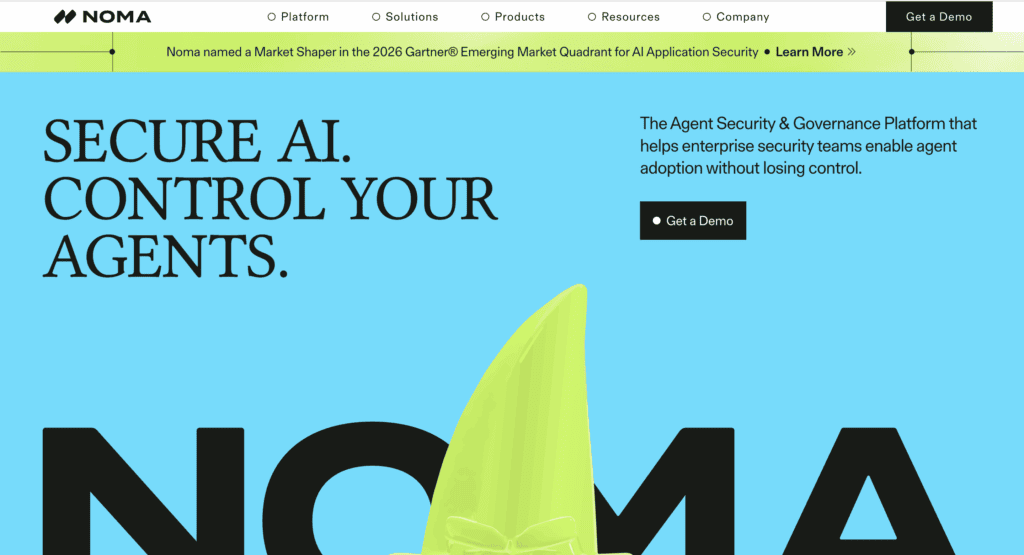
Overview: Noma Security is an agent security and management platform in an enterprise setting. It finds agents, establishes access controls and tracks potentially malicious activities.
How we evaluated it: We visited its official site and product guide. The platform amalgamates AI security posture management, access control, runtime detection, and AI red teaming.
Pros:
- Discovers agents, MCP servers, models and connected tools.
- Applies access policies to individual agents and tools.
- Can stop destructive actions and alert human operators.
Cons:
- Public pricing is not available.
- Implementation requires evaluation of existing agent infrastructure.
Pricing: Custom enterprise pricing, verified November 4, 2026.
Official source: https://noma.security/platform
4. WitnessAI: Best for Enterprise AI Application Protection
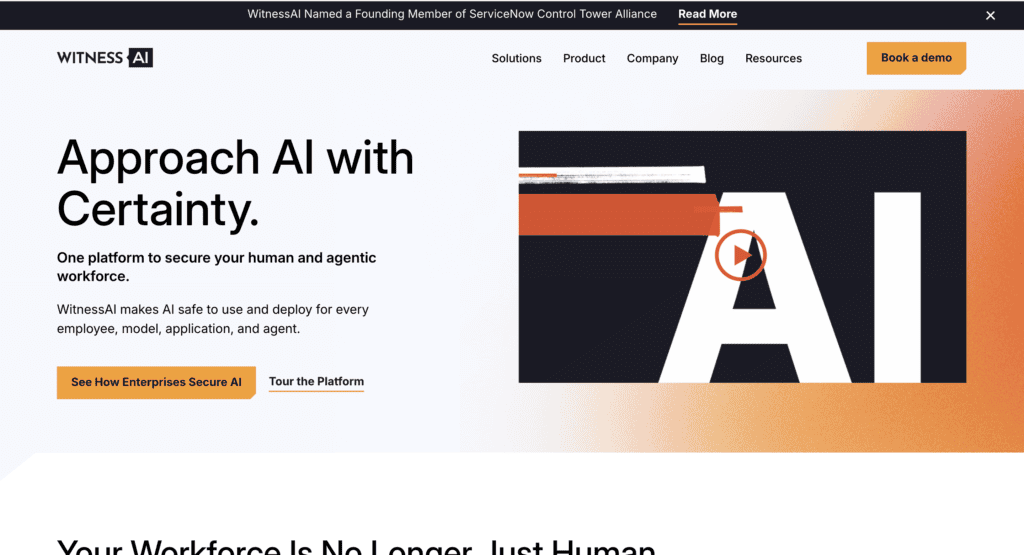
Overview: WitnessAI secures AI applications, models and agents using its Observe, Control, Protect as well as Attack capabilities. Its platform assists businesses in identifying AI activities and create security policies.
How we evaluated it: We reviewed the official Protect product documentation and platform information. Its runtime protection examines prompts before processing and filters responses before delivery.
Pros:
- Detects prompt injection and jailbreak attempts.
- Protects sensitive information through data obfuscation.
- Supports MCP-level governance and agent protection.
Cons:
- Pricing requires a custom quotation.
- Deployment planning may require network and infrastructure coordination.
Pricing: Custom enterprise pricing, verified November 4, 2026.
Official source: https://witness.ai/protect/
5. Lasso Security: Best for AI Red Teaming and Runtime Protection
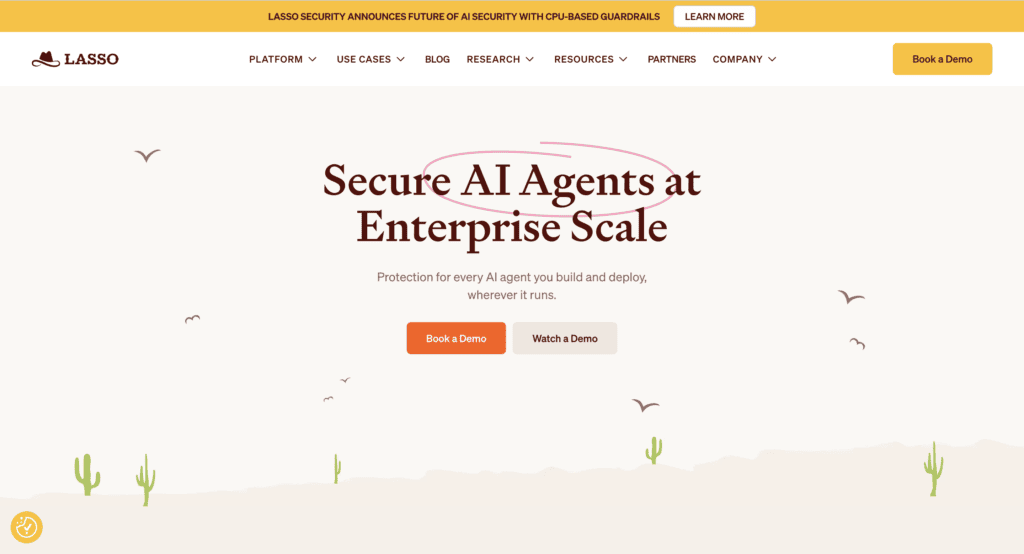
Overview: Lasso Security protects enterprise AI applications and agents throughout their lifecycle. Its platform combines asset discovery, risk assessment, automated red teaming and runtime enforcement.
How we evaluated it: We examined its official AI security platform documentation. The platform describes more than 3,000 attack patterns and supports multi-turn agentic attack simulations.
Pros:
- Inventories AI agents, models, tools and system prompts.
- Tests vulnerabilities through automated adversarial attacks.
- Enforces policies through proxy, API and AI gateway layers.
Cons:
- Public enterprise pricing is unavailable.
- Organisations should validate integration requirements before deployment.
Pricing: Custom enterprise pricing, verified November 4, 2026.
Official source: https://www.lasso.security/platform/ai-security
6. Harmonic Security: Best for Enterprise AI Data Security
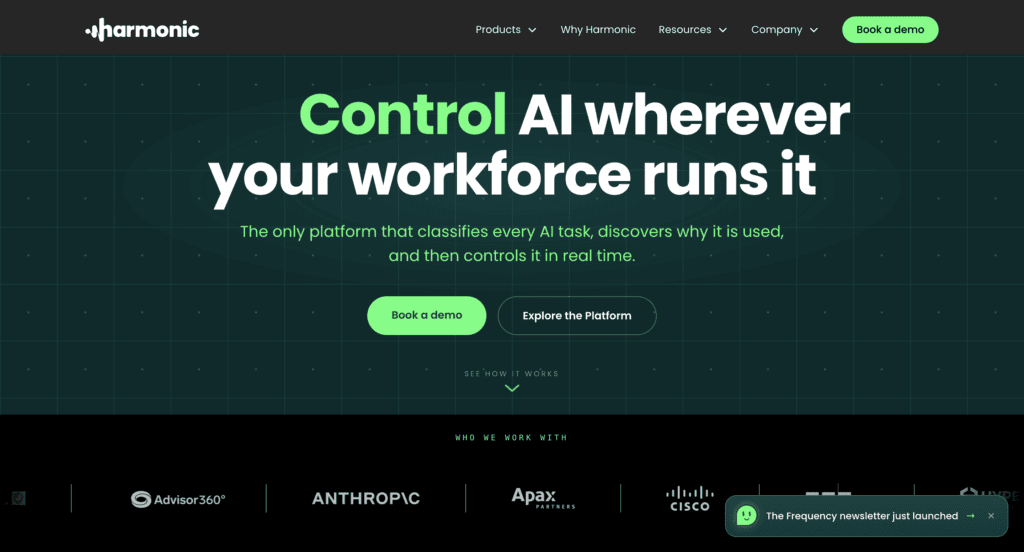
Overview: Harmonic Security protects sensitive business information used across employee AI applications and agentic workflows. Its platform classifies AI activity and applies controls based on data and business context.
How we evaluated it: We reviewed its official product pages and public interactive console preview. Its MCP Gateway monitors tool calls and can block actions that violate organisational policies.
Pros:
- Identifies sensitive information in AI interactions.
- Supports MCP client, server and tool-call monitoring.
- Integrates with endpoint management tools such as Intune and Jamf.
Cons:
- Requires endpoint and gateway deployment planning.
- Organisations should validate coverage across their specific AI applications.
Pricing: Custom enterprise pricing, verified November 4, 2026.
Official source: https://www.harmonic.security/
7. Mindgard: Best for AI Vulnerability Assessment and Red Teaming
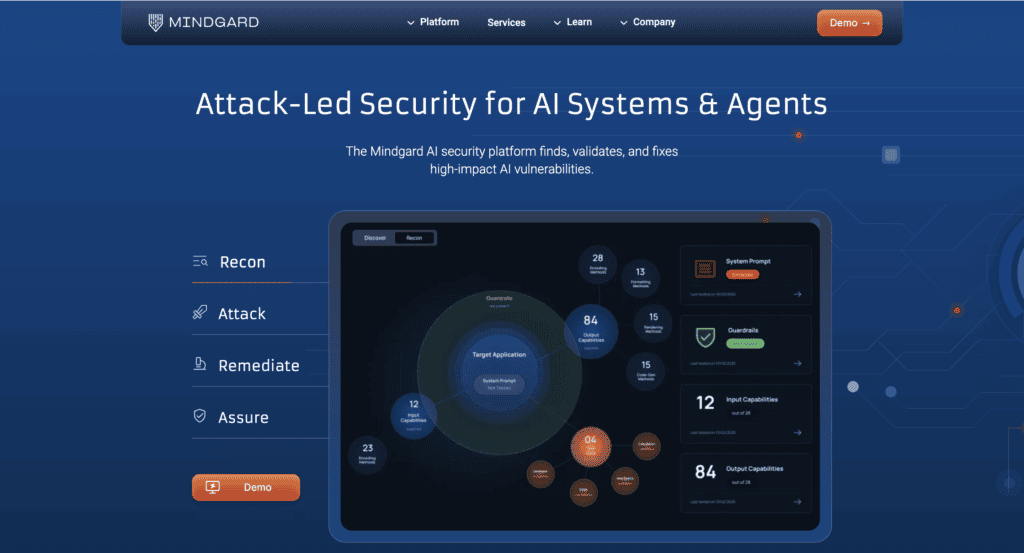
Overview: Mindgard helps security teams identify exploitable vulnerabilities in AI models, applications and agents. Its platform uses attacker-style reconnaissance, automated testing and remediation guidance.
How we evaluated it: We examined Mindgard’s official platform and technical documentation. Its workflow covers reconnaissance, attack simulation, remediation and continuous assurance.
Pros:
- Maps models, agents, tools and AI attack surfaces.
- Uses adversarial testing to identify exploitable weaknesses.
- Integrates with APIs, CI/CD pipelines and security workflows.
Cons:
- Pricing is not publicly disclosed.
- Organisations needing continuous employee AI data controls may require another platform.
Pricing: Custom enterprise pricing, verified November 4, 2026.
Official source: https://mindgard.ai/
AI Agent Security: What Should Enterprises Look For?
AI agent security requires controls beyond conventional model protection. Agent can use files, make calls to APIs, and connect to MCP servers and act on behalf of employees.
The enterprises are to consider agent discovery, identity permissions, tool-call monitoring, and runtime enforcement and audit trails. These capabilities help prevent prompt injection, unauthorised actions and sensitive data exposure. OWASP’s guidance on LLM and agentic application security provides a useful reference for evaluating these controls.
How to Choose the Right AI Security Solutions
Start with identifying what AI assets to secure. Supply chain scanning and vulnerability testing should be considered important by model developers. Autonomous agent deployments by organizations need to focus on access control and runtime enforcement.
Evaluate deployment needs, current security integrations, transparency in pricing and vendor support as well. Get them to show with your actual AI processes, and then select a platform.
Frequently Asked Questions
1. What are AI security platforms?
Models, applications, agents, and related data are safeguarded over the AI life cycle by AI security platforms. They provide features like model scanning, prompt injection detection, sensitive data protection, adversarial testing and runtime enforcement. These platforms allow enterprises to identify weaknesses, and also control the access of information and activities by the AI systems.
2. How do AI security tools protect AI agents?
AI security tools closely monitor data access, runtime operations, agent permissions, connected tools, and data access. They are able to detect prompt injection, unauthorized tool use and prevent actions which infringe organizational policies. Certain platforms also maintain agent inventories and audit trails, which assist security teams to research incidents and handle autonomous operations.
3. How do you choose an AI security platform?
Select a platform according to your threat exposure, security needs and your AI architecture. Test model security, agent governance, data controls, vulnerability testing, integrations and deployment strategy. Request a demonstration, inquire about the technical fit and weigh the total implementation costs before making an enterprise buying decision.
Conclusion
The future of the best AI security platforms in 2026 hinges on which systems require protection by an enterprise. HiddenLayer suits model security, while Zenity and Noma Security focus on agent governance.
WitnessAI and Harmonic Security address AI interactions and sensitive data. Lasso Security and Mindgard provide adversarial testing and vulnerability protection. Evaluate each platform to your current infrastructure and security priorities and then purchase.