AI is transforming the manner in which HRs are managing their recruitment procedures, queries posed by employees, employee onboarding, workforce planning and people analytics.
The appropriate AI tools for HR can cut down on the monotonous work of administration, assist recruiters in organizing interviews, and provide HR practitioners with quicker access to information about the workforce.
However, not all platforms are the same. Others combine AI with payroll and employee management, and others are concerned with recruiting automation, talent intelligence or employee support.
This guide compares 5 AI tools for HR teams. Both platforms provide different functions, including automation of HR processes and streamlining the recruitment process, as well as talent management and employee offerings.
It will compare the main features, pricing models, integrations, advantages, and disadvantages to enable HR professionals to find the best solution to fit their companies.
Best AI Tools for HR Teams: Comparison Table
| Tool | Best for | Key feature | Pricing model | Integrations |
| Rippling | All-in-one HR operations | AI-assisted workflows and workforce insights | Modular; per-employee pricing, custom quote | 650+ app integrations |
| HiBob | Employee management and people operations | Bob AI Companion and HR automation | Custom, generally per employee | Greenhouse, Slack, ADP, Workato |
| Paradox (Olivia) | High-volume recruiting | Conversational screening and interview scheduling | Custom quote | ATS, HCM and CRM systems |
| Eightfold AI | Talent intelligence and skills-based hiring | AI-powered candidate matching and internal mobility | Enterprise quote | Enterprise HR and recruiting systems |
| Leena AI | Employee self-service and HR support | AI assistant and automated employee workflows | Per-employee assistant pricing; separate platform and usage fees for AI Colleagues | Workday, ServiceNow, SAP and 200+ connectors |
1. Rippling
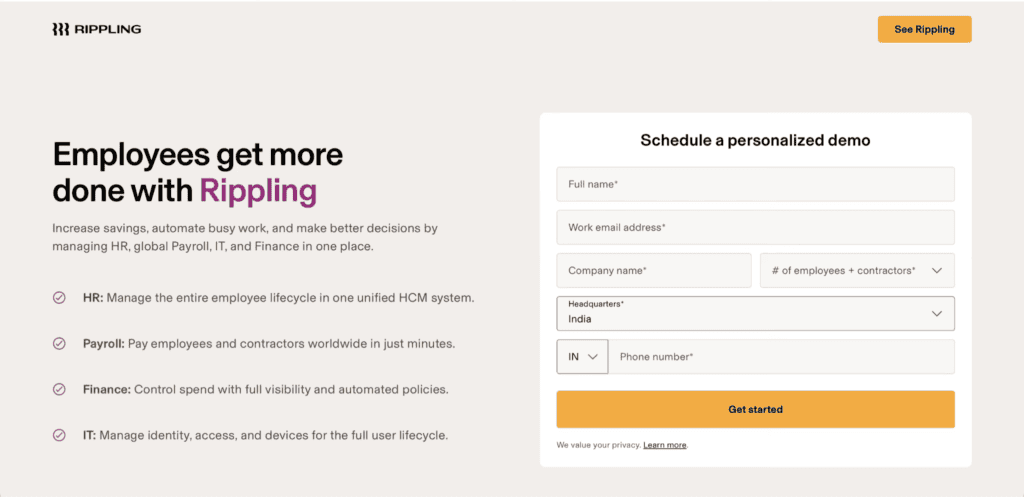
Rippling is a platform that incorporates HR, payroll, benefits, recruiting, and workforce management in a single platform.
Its AI facilitates the professional aspect of HR teams in inquiring the data on the workforce data, compiling reports, and automating operations, including onboarding, modifying employee records, and staff retention analysis. The platform also offers more than 650 integrations.
My experience evaluating this tool: Rippling is a good alternative for firms that desire the use of automated HR that relates to payroll and IT functions.
It is particularly suitable where employee information of the employees is made available across different business systems, but the extent of the modules can prove to be challenging to execute.
Pros
- Connects payroll and HR workflows with records of employees.
- AI supports reporting and selected administrative tasks.
- Extensive integrations reduce disconnected data and manual updates.
Cons
- Multiple modules can increase overall costs.
- Initial configuration may be complex for smaller teams.
- Advanced capabilities depend on the products purchased.
Pricing: According to Rippling, its official pricing page has the following plans: starting at $8 per employee per month, plus a monthly base fee. Actual costs are determined by the selected products and workforce size.
2. HiBob
HiBob, also known as Bob, supports core HR, employee lifecycle management, performance, engagement, workforce planning and analytics.
Its Bob AI Companion assists HR staff in operating with people data and automating routine activities.
There are over 100 integrations with HiBob, such as Greenhouse, Slack, Microsoft Teams, ADP, and Workato.
My experience evaluating this tool: HiBob would be something to consider when expanding organizations interested in having employee experience within one system and people operations within the same system.
It is most valuable when the HR departments require uniform data on employees and their work processes instead of a standalone recruitment chatbot.
Pros
- Combines core HR with performance and engagement features.
- AI capabilities support everyday HR work.
- Integrations connect HR data with recruitment and collaboration tools.
Cons
- Pricing is not fully transparent without a tailored quote.
- Some capabilities require additional modules.
- Organizations should check compatibility with existing payroll systems.
Pricing: HiBob employs tailored pricing, which mostly depends on the number of employees, modular selections, and application requirements. Get in touch with the vendor to receive a detailed quote.
3. Paradox (Olivia)
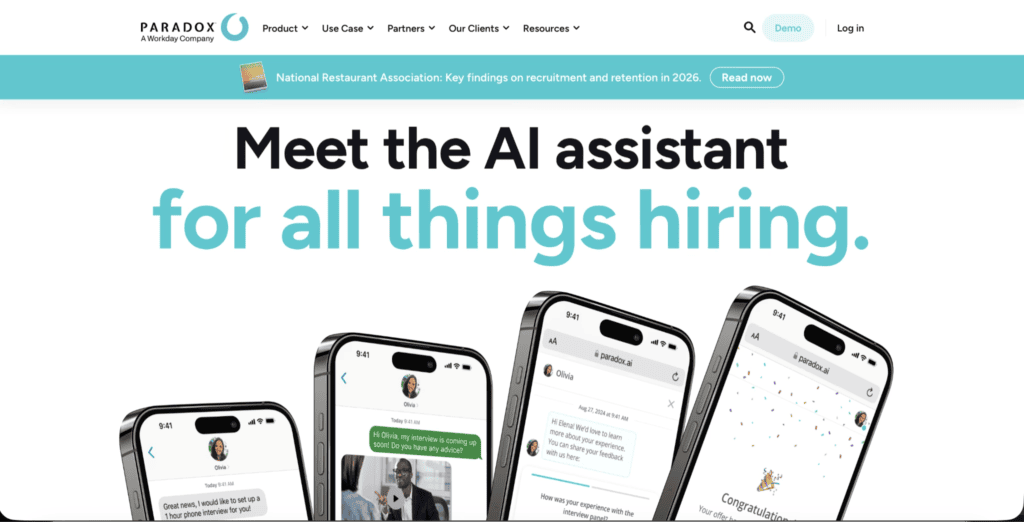
Paradox is an automation recruitment firm, and its conversational AI is Olivia.
It helps applicants and recruiters to use mobile-friendly dialogs, respond to questions that can be asked during the hiring process, conduct mandatory first-level screening and organize interviews.
Such features are specifically relevant to retailers, hospitality businesses and any other employer that has a high number of applicants.
My experience when assessing this tool: Paradox would be a great tool when dealing with large hiring staff with significant volume, in which the bottleneck would be in time-consuming application and scheduling.
Practical testing of the screening criteria and communicating with the candidates should be taken into consideration to be able to provide the system with fair and consistent recruitment.
Pros
- Automates scheduling and reminders for interviews.
- Offers conversational screening of candidates.
- Supports mobile-first recruiting experiences.
Cons
- Less suitable as a complete HR management system.
- Enhanced features rely on recruitment workflow and integrations.
- Monitoring of automated screening should be focused on accuracy and possible bias
Pricing: There is no standard price that is displayed on the pages under review by Paradox. Request a quote depending on the hiring volume, selected capabilities and integration requirements.
4. Eightfold AI
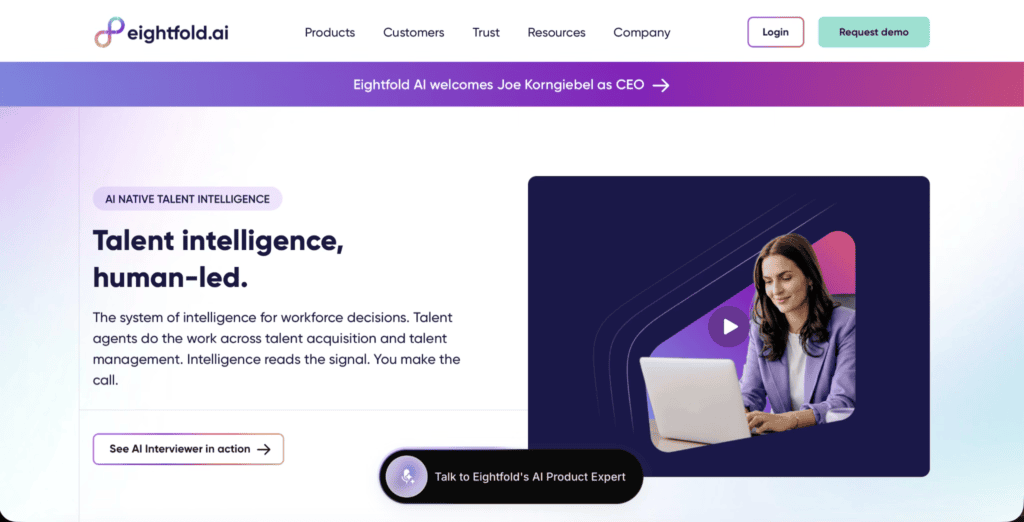
Eightfold AI concentrates on talent intelligence and recruitment, analysis of skills and internal mobility.
Its platform applies AI in pairing candidates with capabilities and potential and helps organizations to locate their skill gaps within the workforce and advance their workforce growth.
My experience regarding the tool: Eightfold AI could be considered in cases, where companies require more complicated recruitment or in case they possess large talent pools in their company.
Its skills-based format can assist recruiters in going beyond resumes, but companies need to define how accurately its recommendations align with those of the job description and make the resultant decision-making accountable.
Pros
- Supports skills-based candidate matching.
- Facilitates the internal mobility and development.
- Linking recruitment to overall workforce planning.
Cons
- May be excessive for small businesses with straightforward hiring.
- Requires reliable talent data and appropriate implementation.
- Pricing and package details need confirmation from the vendor.
Pricing: Eightfold AI employs enterprise pricing which is based on a quote.
Its presence in the SAP’s marketplace gives it a price point for the specific deliverables, however it should not be assumed that it costs the same across all deployments.
Ask for a quotation of the necessary modules and terms of the contract.
5. Leena AI
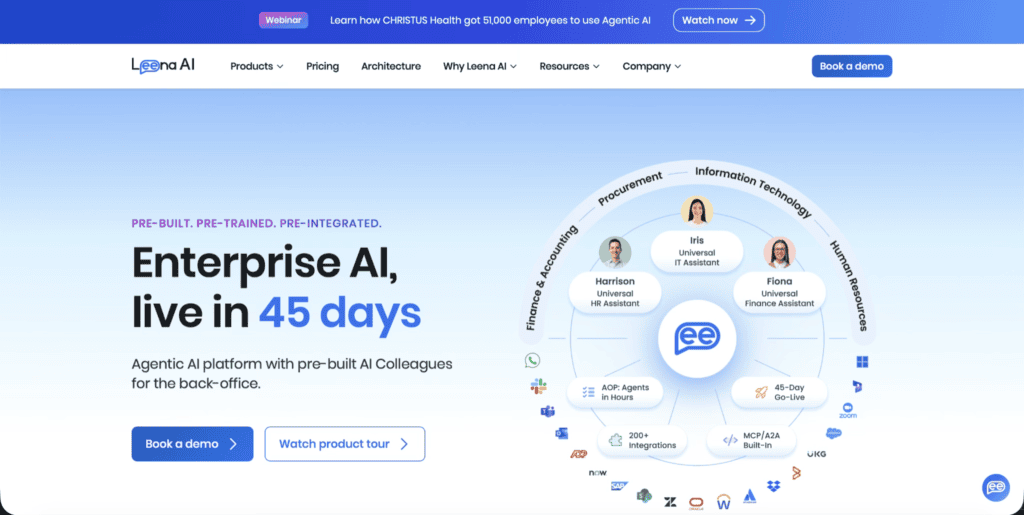
Leena AI offers automation of HR workflows and employee support with AI.
The employee can be assisted with leave requests, payroll questions, benefits, employee records and policy questions with its Universal HR Assistant.
It also has an AI Colleagues Platform where one may have more independent workflows, having integration with Workday, ServiceNow, SAP, and over 200 connectors.
My experience evaluating this tool: Leena AI is specifically applicable to the human resources departments that have to reply to repetitive and similar employee inquiries when using different channels.
Teams must verify prior to implementation how the assistant manages sensitive information about employees, how it escalates strange requests and how it gets permission to take consequential steps.
Pros
- Automates common employee service requests.
- Supports web, mobile, Teams, Slack and phone interactions.
- Offers integrations with enterprise HR systems.
Cons
- Answers and actions need appropriate permissions and oversight.
- Advanced autonomous workflows can introduce usage-based costs.
- Effectiveness depends on accurate policies and connected systems.
Pricing: Leena AI charges a flat annual per-employee fee for its Universal Assistant.
Its AI Colleagues Platform operates based on a yearly platform charge together with token usage fees. Real-time pricing is based on headcount and use cases.
Final Thoughts
The optimal AI application to use in HR departments depends on the size of your organization, recruitment history, and HR requirements.
Compare every platform with actual workflows, seek up-to-date quotations and establish human verification of consequential actions.
Artificial Intelligence (AI) must not replace responsibility, judgment or fair treatment of employees rather it must assist HR professionals to make the processes more efficient.