
The implementation of AI in the enterprise is accelerating faster than organizations ability to manage its risks.
Unmanaged AI uses, exposure to sensitive data, biased results as well as autonomous agents can provoke issues of security, compliance as well as accountability.
AI governance software assists companies in keeping an inventory of AI systems, evaluate risks, record controls and track compliance.
An appropriate AI governance platform can help join legal, security, data science and compliance teams with uniform workflows.
This guide compares five AI governance solutions and each is applied to data protection and model monitoring, as well as enterprise-wide governance.
Comparison of the Best AI Governance Platforms
| Tool | Best for | Key feature | Pricing model | Integrations |
| Credo AI | Enterprise AI governance and compliance | AI inventory, risk assessments and regulatory mapping | Custom quote | Azure AI Foundry, Databricks, ServiceNow, GitHub |
| Holistic AI | AI discovery, testing and enforcement | AI inventory, agent mapping and automated testing | Custom quote | APIs, SDKs, cloud and AI infrastructure |
| Fiddler AI | Model and agent monitoring | Observability, safety guardrails and trace-level insights | Free tier; developer plan at $0.002 per trace; enterprise quote | AI/ML pipelines and model deployment environments |
| ModelOp Center | AI lifecycle governance | Central inventory and automated governance workflows | Custom enterprise quote | 50+ technologies and enterprise APIs |
| FairNow | AI risk and compliance governance | AI inventory, risk scoring and framework mapping | Historical product pricing was quote-based; confirm availability through Optro | Confirm current integrations with Optro |
1. Credo AI
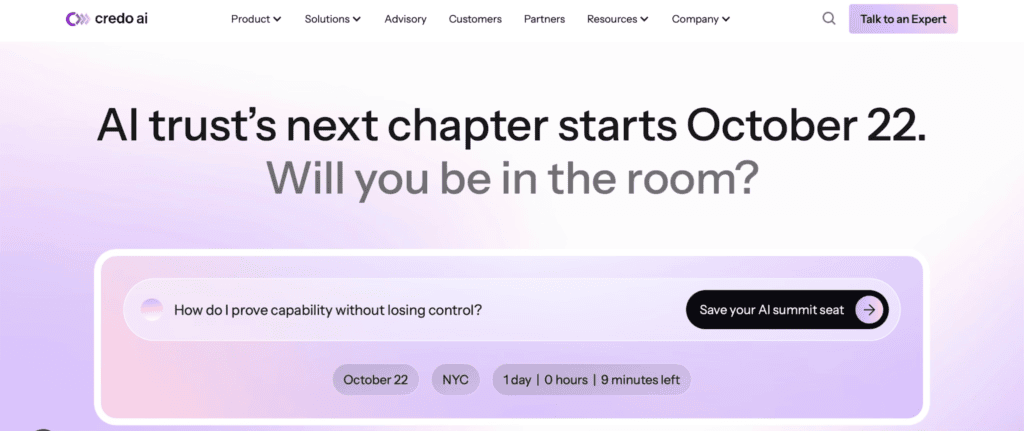
Credo AI is an assistant that can assist companies to oversee AI systems all the way through its lifecycle.
Its platform assists in the discovery of AI, combined inventories, risk assessments, compliance processes and ongoing monitoring.
It is also based on a mapping of the governance requirements to frameworks such as the EU AI Act, NIST AI RMF or ISO/IEC 42001.
These capabilities aid AI model governance which helps organisations in creating routine control of models, risks as well as compliance standards.
My experience evaluating this tool: Credo AI is an excellent add-on for organizations with formal governance program development across a variety of AI models, vendors and use cases.
Its intersections with the system of development and GRC tools will be capable of bridging the gap between governance policies and daily processes.
Pros
- Centralizes AI inventories, risk assessments and compliance evidence.
- Supports governance for AI agents as well as conventional models.
- Integrates with platforms including Databricks, ServiceNow, GitHub and MLflow.
Cons
- Enterprise pricing requires a direct quote.
- Assessment and approval must have a specific team to be utilized.
- The scope of implementation might increase with the increase of governance requirements.
2. Holistic AI
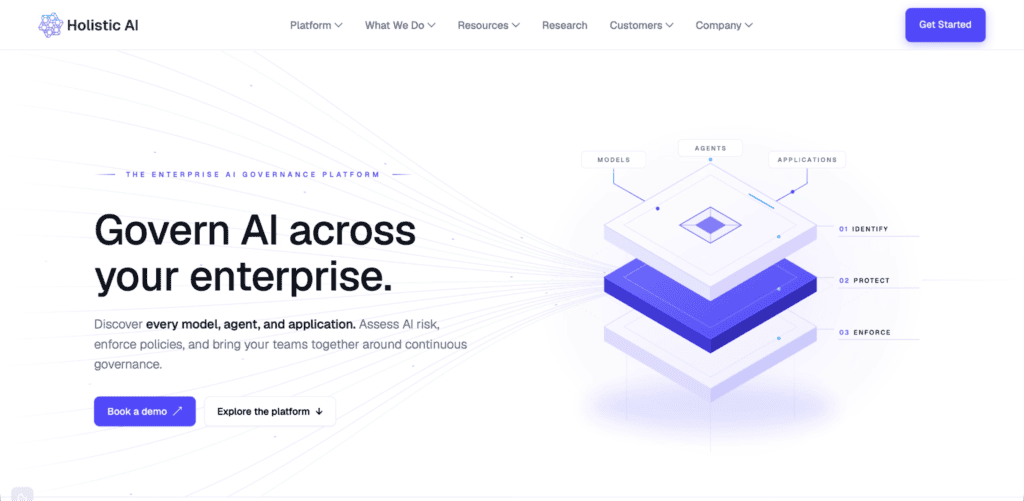
Holistic AI involves AI discovery, testing, risk assessment and policy enforcement.
Its platform has the capability to store AI models, applications and agents, and visualize connections among components, and test systems for issues like bias, security weaknesses, hallucinations and drift.
It also helps to create governance aligned with standards like ISO 42001 and NIST AI RMF.
My experience evaluating this tool: Holistic AI may be recommended in a situation when an organization requires both governance checks and technical testing.
The relevance of its discovery and agent-mapping features are especially noted when AI is implemented across departments without centralized visibility.
Pros
- Integrates AI discovery, testing and governance enforcement.
- Helps detect unapproved AI and relationships between agents and models.
- Assists in monitoring and compliance processes.
Cons
- Broad functionality may exceed the needs of organizations with only a few AI systems.
- Testing results still require interpretation by qualified teams.
- Pricing depends on the enterprise deployment and requirements.
3. Fiddler AI
Fiddler AI focuses on AI observability, security and monitoring.
It helps the teams to determine and test the functionality of a model, investigate unintended behavior and locate the bugs such as hallucinations, bias, exposing sensitive information, prompt injection and attempted jailbreaks.
Its guardrails and monitoring capabilities also support agentic AI applications.
My experience evaluating this tool: Fiddler is the most appropriate tool when a company requires the ability to visually understand the behavior of AI once it is in use.
It may be used to supplement an enterprise AI governance program, but it is more monitoring-based than platforms that are centered on policy management and governance approvals.
Pros
- Measures the quality, safety and performance of AI.
- Offers guardrails on the identified risks among the LLMs and agents.
- Offers a published developer price for usage-based monitoring.
Cons
- Observability is not necessarily a substitute to an entire governance program.
- Advanced enterprise deployment and support require a sales conversation.
- Teams need to configure suitable evaluations and response policies.
4. ModelOp Center
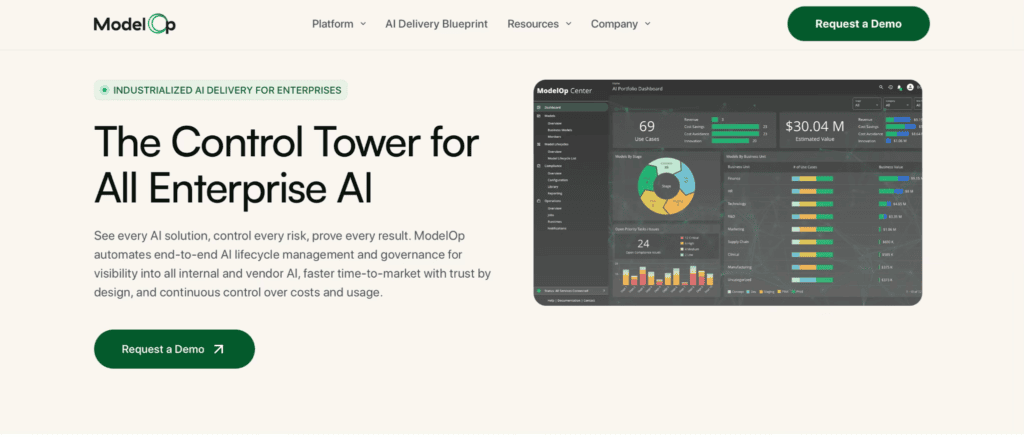
ModelOp Center is an AI platform that provides AI governance and management at the enterprise level.
It helps organizations in the registration of AI use cases, risk assessment, route approvals, and policy enforcement and tracing of AI systems through the intake and deployment to retirement.
Its platform enables both traditional machine learning, generative AI, agentic AI and third-party AI.
It also supports AI agent governance by helping enterprises establish oversight processes for AI agents throughout their lifecycle, from initial registration to deployment and retirement.
My experience evaluating this tool: It is a specific tool that is applied to large businesses when there are reasons to conduct routine monitoring of the development teams and technology landscape.
Its lifecycle approach would be capable of leveraging governance requirements with operational delivery as opposed to leaving policies in standalone documents.
Pros
- Centralizes AI inventory, risk and lifecycle records.
- Automates the administration procedures and policy executions.
- Ecosystems support both clouds, on-premise and hybrid environments.
Cons
- Implementation of an enterprise might involve integration between technical and governance teams.
- Organizations with limited AI deployments may not need its full scope.
- Public pricing is not available for straightforward cost comparison.
5. FairNow
FairNow came up with AI governance capabilities to determine risk assessment, bias testing and regulatory compliance.
Its historical platform in favor of AI inventories, automated bias assessment and reporting for frameworks and requirements like NIST AI RMF, ISO 42001 and NYC Local Law 144.
However, in October 2025 Optro acquired FairNow, so a buyer must make sure how its capabilities are now packaged and sold.
My experience evaluating this tool: FairNow is pertinent in cases where AI fairness and regulatory evidence are key concerns.
Since it is acquired, it is to be reviewed as a part of Optro’s current AI governance, rather than assumed to be an entirely independent vendor.
Pros
- Dedicated to AI risk, bias evaluation and compliance.
- Helps with automated testing and reporting.
- This can be supplemented by its functionality to larger risk and audit activities.
Cons
- Standalone availability and current packaging ought to be checked.
- Direct comparisons are challenging with custom pricing.
- Bias testing may not guarantee that an AI system will be fair in every case.
Final Thoughts
The most effective AI governance tools will assist the enterprise to control AI risks without impeding responsible innovation.
Compare platforms with your current systems, maturity of governance and regulatory requirements.
The following permissions of agents in agentic AI governance, logs of their actions, action control and escalation processes should be paid particular attention to.
Enquire and verify the vendors always in terms of price and quantity of the product before making a purchase decision.