
The area of enterprise risk management is getting complicated as organisations have to deal with cybersecurity threats, emerging regulatory changes, third-party vulnerabilities and operational disruptions.
The disconnected spreadsheets poses a managerial challenge in managing such risks because it may be hard to detect the emergent problems and to control and coordinate any responses within departments.
AI risk management software helps enterprises to concentrate risk information, automating risk assessments and increasing the visibility of potential risks.
AI features are capable of summarizing documents, suggesting controls, detecting gaps and aiding in predictive analysis depending on the platform.
However, the human supervision of the AI-generated suggestions is required particularly when the consequences of the suggestions are affecting compliance, business or security-related decisions.
The guide contrasts five AI in risk management tools, their characteristics, applicability in practice, opportunities, limitations, integrations, and pricing models.
Comparison of the 5 Best AI Risk Management Tools
| Tool | Best for | Key feature | Pricing model | Integrations |
| LogicGate Risk Cloud | Customisable governance, risk and compliance (GRC) | AI-assisted workflows and configurable GRC processes | Custom quote; application and licence-based | Jira, Slack, Microsoft 365, REST API |
| Riskonnect | Enterprise-wide and operational risk management | Integrated risk intelligence and predictive analytics | Custom quote; subscription and potential implementation fees | Enterprise connectors, APIs and Agentforce 360 |
| Mitratech Alyne | Risk assessments and compliance programmes | AI-supported document analysis and assessment templates | Custom quote | Data providers, Snowflake and business intelligence connections |
| Optro | Connected enterprise risk, audit and compliance | Unified risk information and analytics | Flexible, quote-based plans | Power BI, Tableau, Jira, ServiceNow, Teams and Slack |
| Resolver | Enterprise risk, controls and incident management | AI-assisted control analysis and risk workflows | Custom quote based on solutions and requirements | APIs and enterprise application integrations |
1. LogicGate Risk Cloud
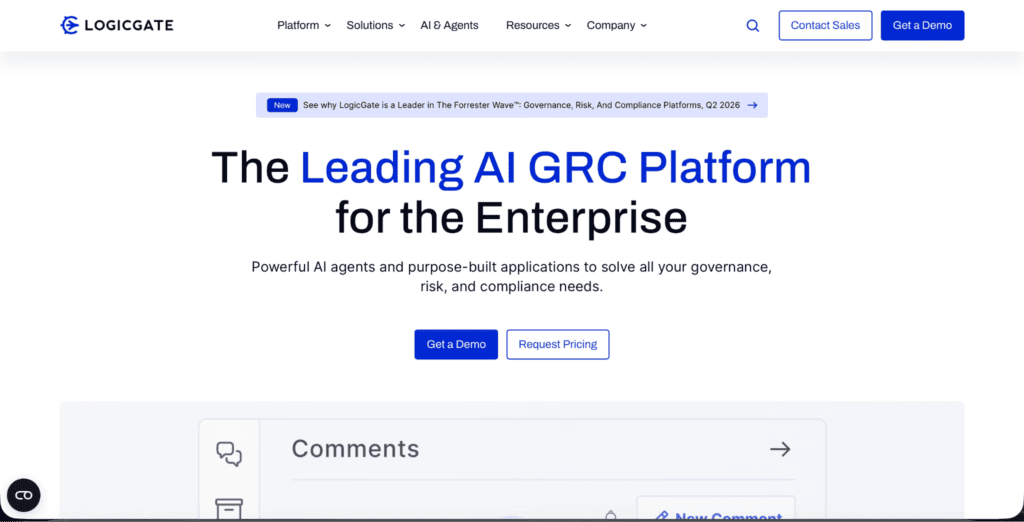
LogicGate Risk Cloud is a platform that has been designed to assist businesses with augmenting the assessment of risks, controls, evidence and remediation procedures.
It uses a no-code process that enables teams to customize workflows to their processes without having to code and create every application from scratch.
The platform has AI capabilities for drafting, summarising and surfacing insights.
Its GRC Agents can be used to facilitate more action oriented processes (like executing assessments), however, these agents are offered as an optional add-on rather than being included automatically in every subscription.
My experience evaluating this tool: According to its functionality declarations, Risk Cloud can be recommended to companies that need flexible workflows and want to introduce AI into current GRC processes.
Pros
- No-code workflow configuration supports changing business requirements.
- AI skills are included with Risk Cloud subscriptions.
- Integrations include Jira, Slack and Microsoft 365, alongside API-based connectivity.
Cons
- GRC Agents can add to the overall expense since they are an add-on.
- The complicated workflows may demand implementation planning and specialist assistance.
- The teams need to confirm AI features that they have in their subscription.
Pricing: Pricing is based on applications and licences, with additional features or services potentially affecting the final cost.
2. Riskonnect
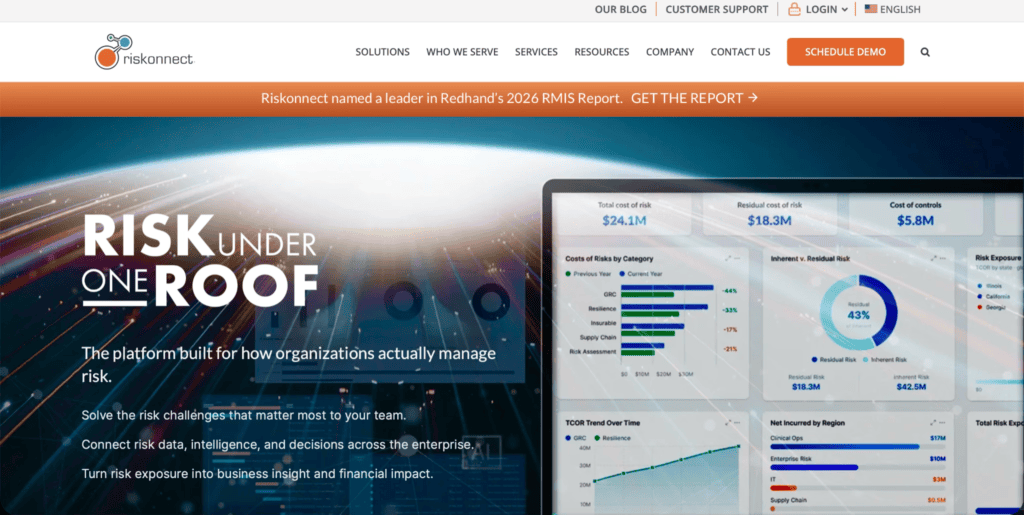
Riskonnect aims at linking risk data amongst business functions, such as operational risk, resilience, claims and other business risk disciplines.
Intelligent Risk is also its capability to deploy AI and analytics to assist teams in analyzing information, finding patterns, and making decisions.
The capabilities are summarized in large language models, risk and control recommendations, predictive analytics and workflow coordination that is based on AI.
In February 2026, Riskonnect also declared an expansion of its enterprise approach to AI utilizing Salesforce Agentforce 360.
My experience evaluating this tool: Riskonnect seems to be especially useful in big organisations, which require a consolidated perspective of risk across departments instead of a standalone risk register.
Pros
- Integrates a variety of risk practices within a larger management framework.
- Predictive features and AI-facilitated summaries can assist the teams with the analysis of risk information.
- Enables business-wide risk awareness and coordinated actions.
Cons
- Functionality is available based on the modules and implemented choice.
- Its broad scope may be unnecessary for organisations with a narrow risk management requirement.
- During procurement, integration, configuration and implementation costs need to be validated.
Pricing: Riskonnect uses customised enterprise pricing.
3. Mitratech Alyne
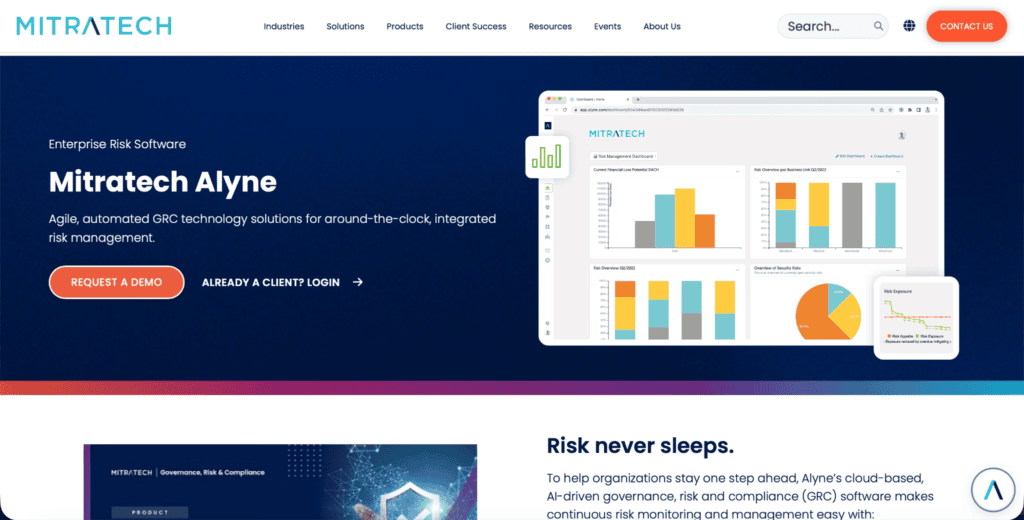
Mitratech Alyne is an enterprise risk management, cybersecurity risk, third-party risk and regulatory compliance cloud-based GRC platform.
It integrates dashboards, customizable workflows and artificial intelligence-enhanced analysis to assist teams to evaluate the risks and track compliance needs.
Alyne contains over 1,500 ready-to-use templates with frameworks and requirements which include ISO 27001, SOC 2 and NIST.
Its artificial intelligence abilities allow it to decode policies and operational documents, support risk identification and summarise information for reporting.
My experience evaluating this tool: Alyne can be offered to organisations with regular assessments conducted on various compliance frameworks.
Its template library might minimize the amount of setup work done more than once, but teams are advised to ensure the viability of the templates available to their industry and regulatory requirements.
Pros
- More than 1,500 templates provide a starting point for assessments and compliance mapping.
- AI supports document interpretation, risk identification and reporting.
- No-code workflows and dashboards can help non-technical teams manage risk processes.
Cons
- Ready-made templates may require tailoring to internal policies and business risks.
- Organisations should validate AI-generated findings before making compliance decisions.
- The fit and value depend on the integrations, frameworks and modules required.
Pricing: Alyne does not publish a standard enterprise price on its official product page.
4. Optro
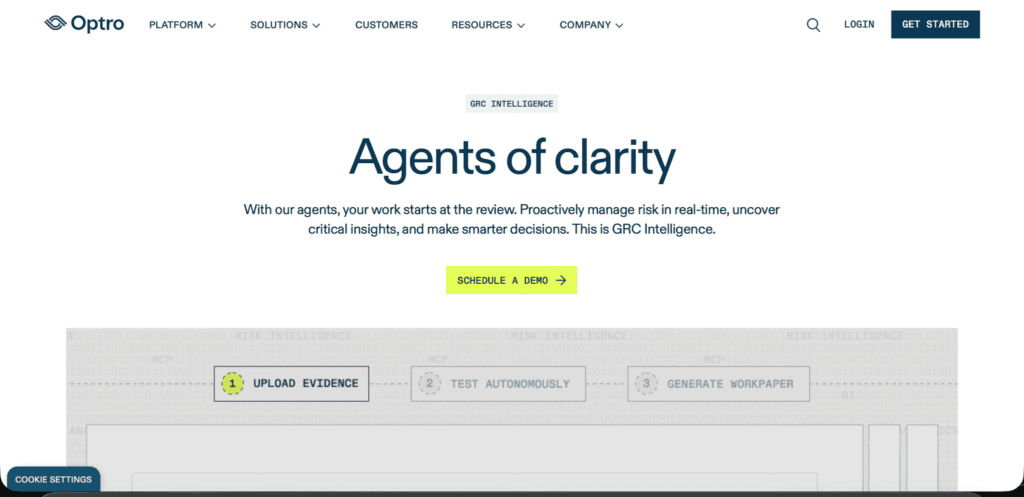
Optro offers the related functionality of enterprise risk, internal audit, IT risk, third-party risk and compliance.
It is applied in such a way that the teams are able to bring together risk information and remediation activities rather than treating them with separate tools.
In the case of third-party risk, the Optro reports that vendor tests supported by AI have the capability to analyse the existing security and compliance reports to create responses in a questionnaire.
It has integrated functions with Power BI, Tableau, Jira, service now, Microsoft teams, slack among other business systems.
My experience evaluating this tool: Optro is a tool that should be evaluated in the case that risk management should be linked to audit, security and vendor management.
Its integrations are especially instrumental in those organisations that desire flow of risk information between their current systems.
Pros
- Brings together enterprise risk, audit, IT risk and third-party risk workflows.
- Repetitive tasks in questionnaires can be minimized with the help of AI-assisted vendor assessment.
- Reporting and remediation are based on BI, ticketing and collaboration integrations.
Cons
- The platform could be larger than the smaller teams require.
- With quote-based pricing, it is hard to make direct cost comparisons without a sales proposal.
- Your technology stack should be verified to have integration availability and configuration requirements.
Pricing: Optro offers flexible, quote-based plans and advertises unlimited stakeholder licenses.
5. Resolver
Resolver assists companies in linking risk evaluations, controls, incidents and remediation procedures.
Its risk and control management features make use of AI to acknowledge possible control gaps and detect overlapping controls and enhance the visibility of how controls are correlated with business risks.
Monthly controls, along with recommendations, and controls can also be generated through Resolver, which provides draft controls based on the applicable risks and requirements, generated by AI.
Its documentation clearly says that the generated content needs to be reviewed and edited by the user and later connected to a risk or requirement.
My experience evaluating this tool: Resolver can be mentioned as a relevant option for organisations that require tracking the connection between known risks, coverage of controls and remediation.
It can potentially be of great help in situations where it is important to have audit readiness and similar risk reports.
Pros
- Connects risk, control and incident information to improve visibility into exposure.
- AI can suggest or draft controls and help identify gaps or overlaps.
- Configurable workflows support structured assessments and remediation.
Cons
- AI-generated controls require review and approval by knowledgeable staff.
- A comprehensive platform may be unnecessary for basic risk registers.
- Pricing and implementation requirements need to be assessed against the organisation’s scope.
Pricing: Resolver will provide custom pricing depending on the solutions chosen, configuration needs and the number of users.
Final Thoughts
The most effective AI risk management software is the software that best suits the risk management structure of your organisation, and its current technology and governance needs, as opposed to one with the most AI functionality.
Use your own workflows as you shortlist the vendors, and receive written and itemised prices.
Regardless of whether AI-based assessments and controls are defined as such, they are to be viewed as a decision-support output, which can then receive the proper assessment by human beings.



[…] most effective AI governance tools will assist the enterprise to control AI risks without impeding responsible […]