
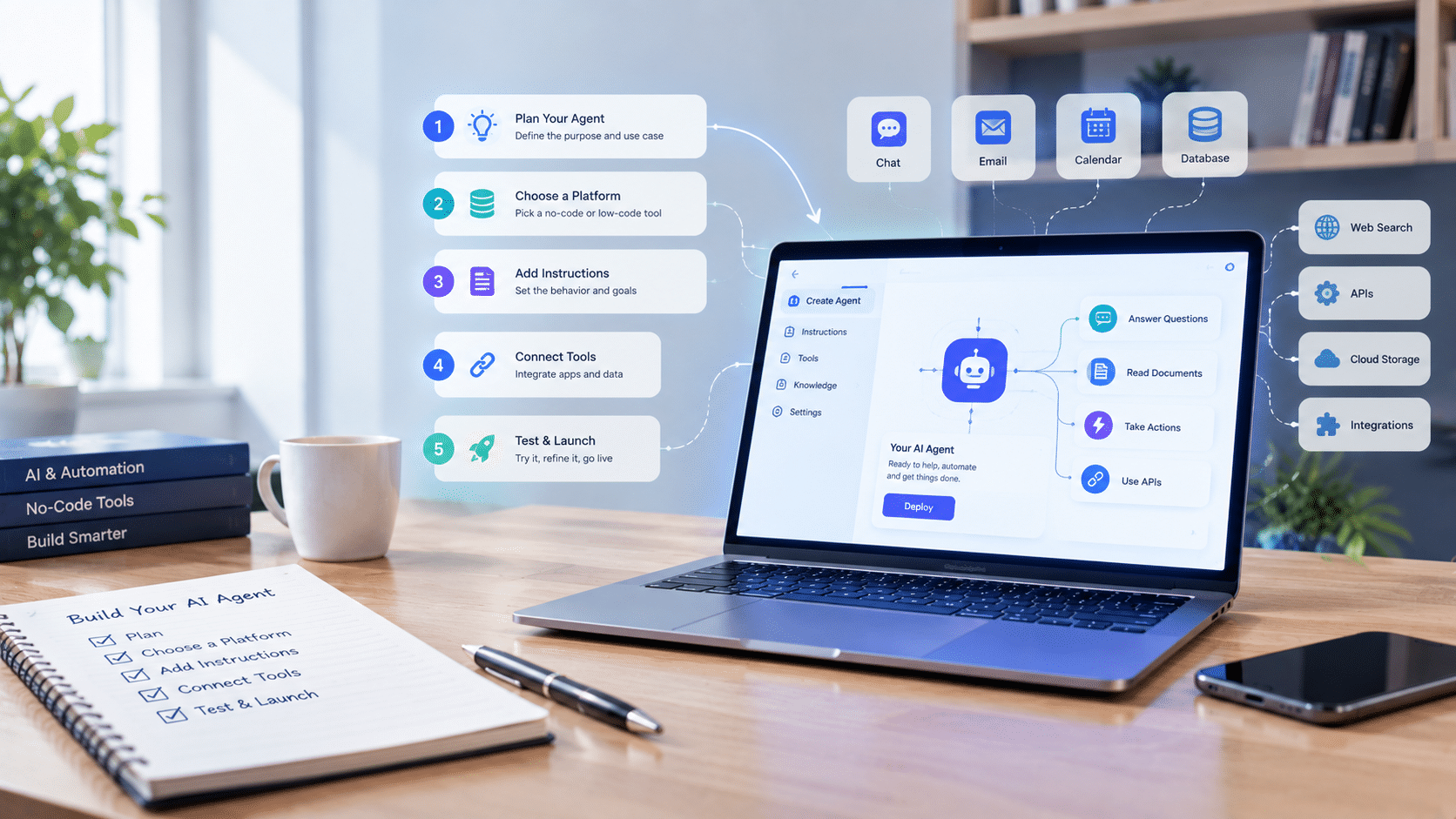
No longer do you require a huge engineering effort to create an AI agent.
Suppose that you desire an assistant checking the incoming mail, identifying the important requests, searching the information in your corporate documents, and drafting a reply.
An average chat bot is able to respond to questions, whereas an AI agent may make decisions, employing tools, recall, and performing a task.
It is noteworthy.
The good news? To create your own AI agent, you do not require a complicated software architecture.
What Is an AI Agent?
A combination of five things makes an AI agent:
AI model + instructions + knowledge + tools + actions.
An example is when a customer-support agent receives a question, he/she can look in an order system, search a company knowledge base, or know what information is relevant to the question and respond to it or even send the one to a human.
It is a very straightforward notion an agent ought to possess some task to accomplish, not merely a call to respond.
How to Build an AI Agent Step by Step
1. Start With One Specific Problem
The biggest mistake is starting with, “I want to build an AI agent.”
Instead, ask: What repetitive task should this agent handle?
Good first projects include:
- Sorting customer emails
- Answering questions from internal documents
- Qualifying sales leads
- Creating weekly reports
- Scheduling appointments
- Checking invoices
- Summarizing meetings
Start narrow. A faithful agent is better than one that allegedly does everything.
2. Define What the Agent Can and Cannot Do
List the duties of the agent.
For example:
The process includes the agent, survey of immediate support email, problem recognition, search and then response to the problem as well as escalation of billing or sensitive complaints to a human being.
Boundaries have set parameters. Actions that the agent cannot take should also be defined by you.
For example, it can advise a refund, and the same will require a human to approve it.
This is especially important when an agent will access business systems.
3. Choose the AI Model
Next, pick the model which will provide a power to the agent.
You need not necessarily possess the very best model which can be purchased.
The more complex reasoning may warrant a stronger model, as well as simple customer queries or extraction or classification may only need a smaller or faster model.
Your platform may have the capability of letting you choose the model or may choose a model in your international.
4. Give the Agent Knowledge
The AI model does not automatically know the private information of your company.
When your agent should respond to questions regarding company policies, products, pricing or procedures, you need to identify sources approved.
These might include:
- PDFs
- Knowledge bases
- Websites
- Databases
- Internal documents
- FAQs
This is often called retrieval-augmented generation, or RAG.
Question
↓
AI Agent
↓
Search Knowledge Base
↓
Relevant Information
↓
AI Model
↓
Grounded Response
The goal is to make the agent use relevant information instead of guessing.
5. Connect Tools and APIs
An AI agent can be of great use here.
Suppose, your agent is required to arrange a meeting. Provide it with access to a calendar tool.
In need of checking an order? Link it to the order-management API.
Request to make a support ticket? Give it permission to use your ticketing system.
The simplified process will be:
Understand → Decide → Use tool → Check result → Continue → Complete
6. Add Rules and Guardrails
Always keep the agent Tier 1 when it will partially exploit an agent (has to possess the necessary tool).
Define permissions carefully.
For example:
CAN:
- Search customer records
- Draft emails
- Create support tickets
CANNOT:
- Delete customer records
- Issue refunds automatically
- Change account permissions
For sensitive actions, require human approval.
7. Test Before You Deploy
Give the agent realistic situations, not just easy questions.
Test what happens when:
- Information is missing
- A customer asks an unrelated question
- Two documents contradict each other
- A tool fails
- The user changes their request
- The agent does not know the answer
Track both successful and failed runs.
Your first version does not need to be perfect.
It needs to show you where the agent breaks so you can improve it.
Platforms to Build an AI Agent
You do not necessarily have to write all the code yourself.
The process is much simpler with several smaller or specialized platforms.
Gumloop
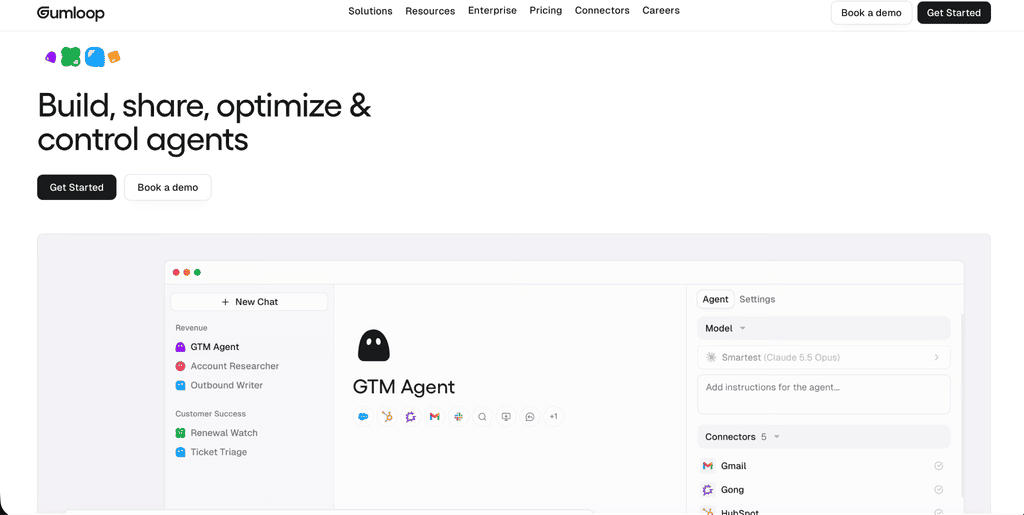
Gumloop is a visual AI platform to create AI agents and automations to sales, support, data, meetings and CRM tasks in business.
Its present builder allows users to specify what an agent should deal with, bind applications, and provide instructions and triggers.
Useful: For teams that do not wish to work out the entire infrastructure themselves to create business agents.
Relevance AI
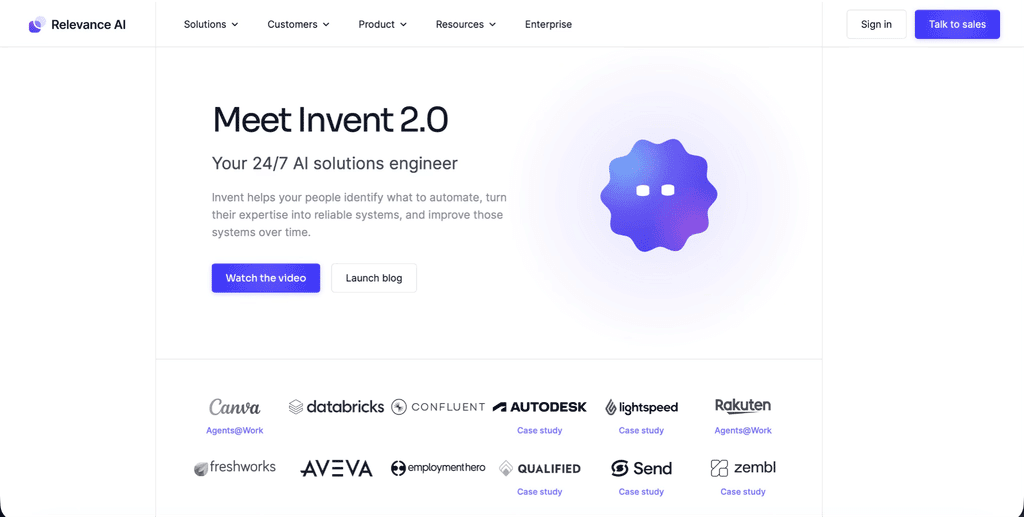
Relevance AI aims at developing AI workforces comprised of specialized agents.
It offers mechanisms to construct, coordinate, assess, and operate a variety of agents, so it can come in handy when a workflow needs a number of AI workers, and not just one assistant.
Best at: Sales, operations and multi-agent workflow investigators.
Dify
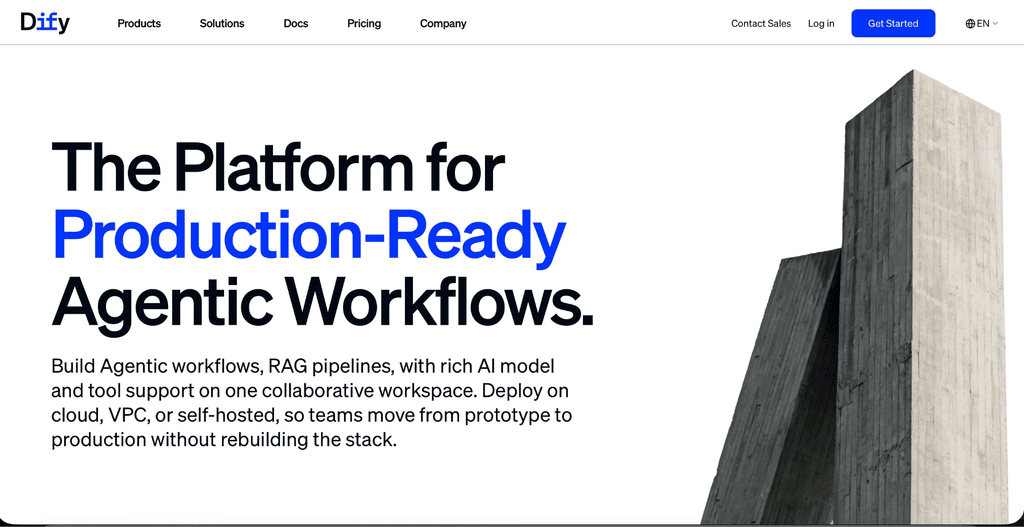
Dify is an open-source platform to create AI applications, workflows, and RAG systems and agents.
It is especially applicable in cases where developers wish for more control over the way an AI application is built and implemented.
Good: Technical teams that require flexibility and self-hosting.
Lindy
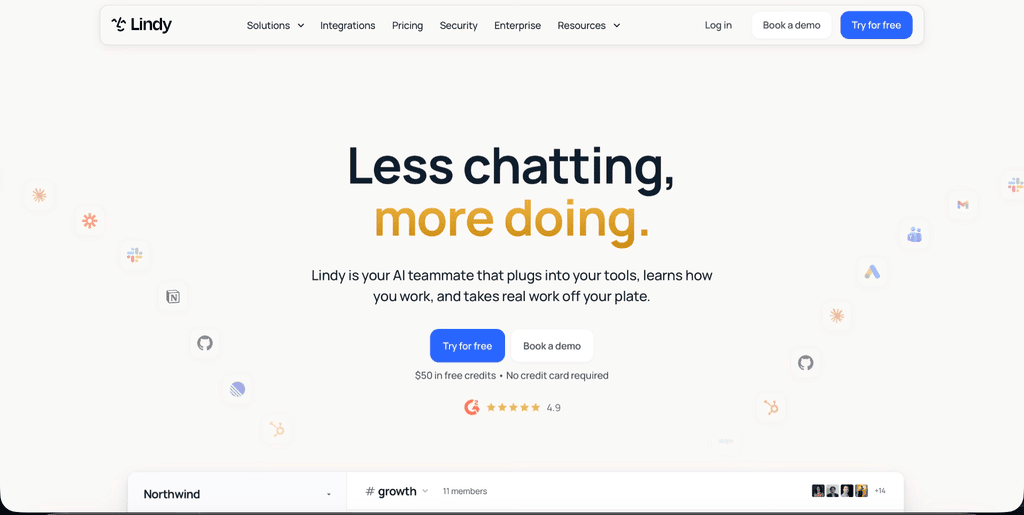
Lindy is more approachable with a no-code approach. It is constructed on AI assistants, which can be used with email, calendar, meetings, and CRM.
Useful: Small teams and people who do not need to develop a complete technical stack to create useful agents.
Final Thoughts
You do not have to be an AI researcher or possess an AI research team as large as that in order to build an AI agent.
Begin with a single repetition problem.
Provide the agent with explicit instructions, tie it to the information it may need, only provide tools necessary to it, create limits on permissions and test the agent in real-life situations.
In case you are interested in build your own AI agent, you should begin with a small one.
You might just have your first agent read the requests that come in and prepare the following course of action.
When that has been proven to be trustworthy, add tools, add automation, and still more intricate decision-making.
And when you want to build an AI voice agent, the same platform can be used, you just plug in a voice interface and telephony layer at the top of the reasoning, knowledge, tools and activities of the agent.
The technology will keep on changing. The practical application is almost unbelievably easy: assign AI a task, provide it with the tools required, control what can be achieved, and continue to perfect it based on real results.