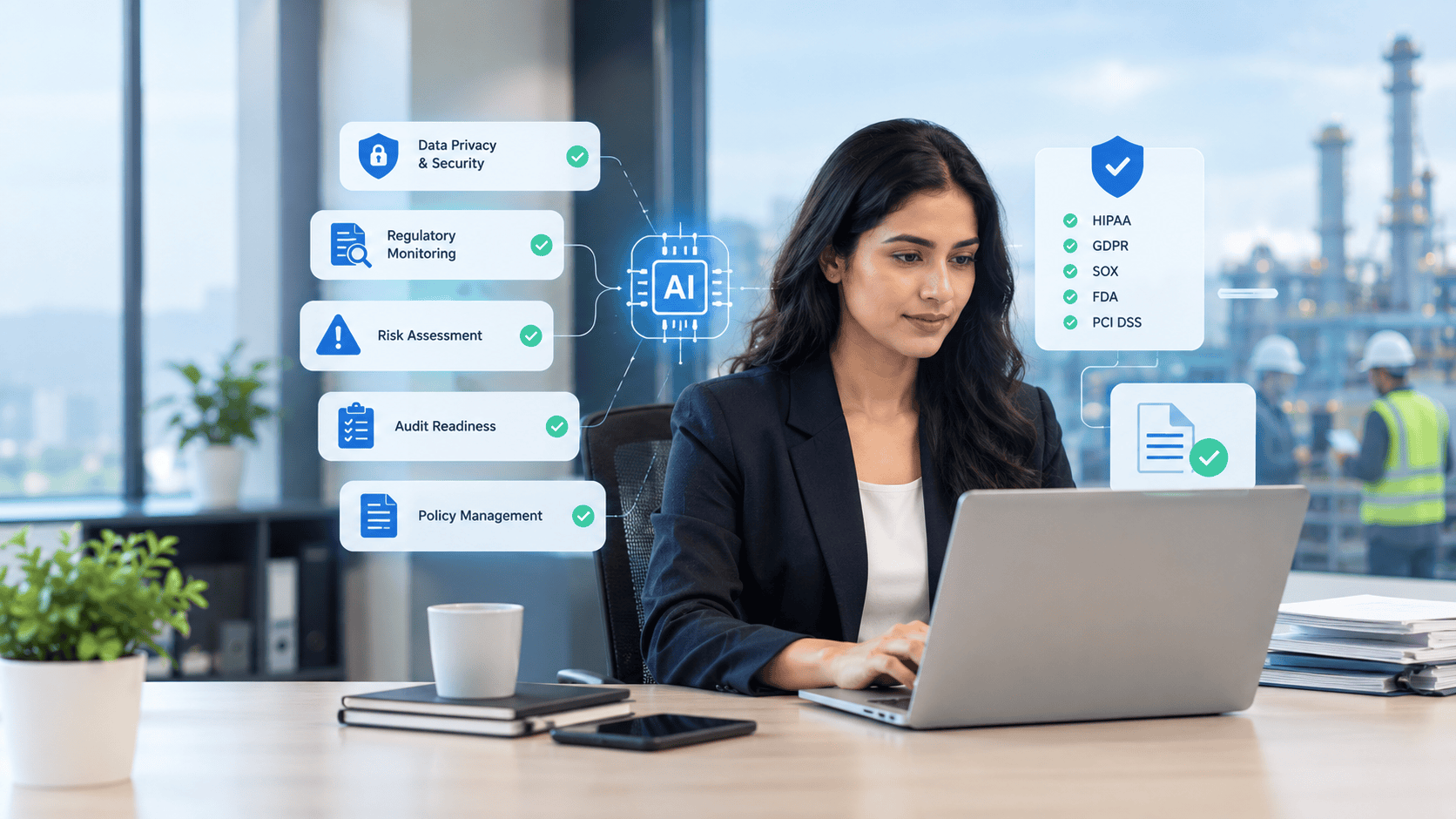
The compliance team takes hours to seek evidence, verify policies, scrutinize controls, and organize an audit.
Then AI enters the picture, and suddenly there is another question to answer: Who is making sure the AI itself is being used responsibly?
That is what lies ahead for regulated organizations in 2026. AI can cut down on repetitive compliance work, though it also poses new risk on data, model behavior, accountability, privacy, and oversight.
NIST’s AI Risk Management Framework recommends four ongoing functions for managing these risks: Govern, Map, Measure, and Manage.
This is the point of modern AI compliance tools.
Instead of fully involving spreadsheets and manual review, organizations have an option to employ software to streamline evidence gathering, evaluate AI risk, control monitoring, manage regulatory demands, and generate audit-prepared records.
But these platforms are not interchangeable.
Some focus on security compliance and audit readiness, while others are built specifically for AI governance or broader GRC programs.
The following are six platforms that can be used in evaluating AI tools for compliance in controlled settings.
Key Takeaways
- Evidence can be collected, testing can be controlled, risk assessments and policy workflows can be automated with AI compliance tools and many other repetitive compliance measures.
- The AI governance platforms may also assist organizations in cataloging AI systems, evaluating risks, setting up control and checking on AI applications.
- Vanta and Drata are more of a compliance automation system and AI-operated workflow, whereas Credo AI and OneTrust are much more concerned with AI governance.
- Hyperproof introduces AI functionality to wider GRC and compliance operations, and Workiva links AI to audit, risk, controls, and reporting.
- Organizations that are regulated ought to consider auditability, data management, human control, integrations, framework coverage, and control efficiency, prior to choosing a platform.
- NIST’s AI RMF can offer a valuable scheme that can be used to organize AI risk management within an organization.
AI Compliance Tools Compared
| Platform | Best suited for | Main focus | Notable AI capability |
| Vanta | Security and compliance teams | Compliance, risk and audit readiness | AI Agent and automated compliance workflows |
| Drata | Growing regulated organizations | Compliance, risk and assurance | AI-powered compliance and agent governance |
| OneTrust | Enterprise AI governance | AI risk, privacy and governance | AI inventory, risk assessment and runtime controls |
| Credo AI | AI-intensive enterprises | AI governance and regulatory alignment | AI inventory, policy mapping and risk management |
| Hyperproof | GRC teams | Compliance, risk and evidence management | AI-assisted discovery, validation and remediation |
| Workiva | Enterprise audit and risk teams | GRC, controls and reporting | AI-powered audit, risk and controls workflows |
1. Vanta
Best for: Organizations that want to automate security compliance and strengthen their overall GRC program.
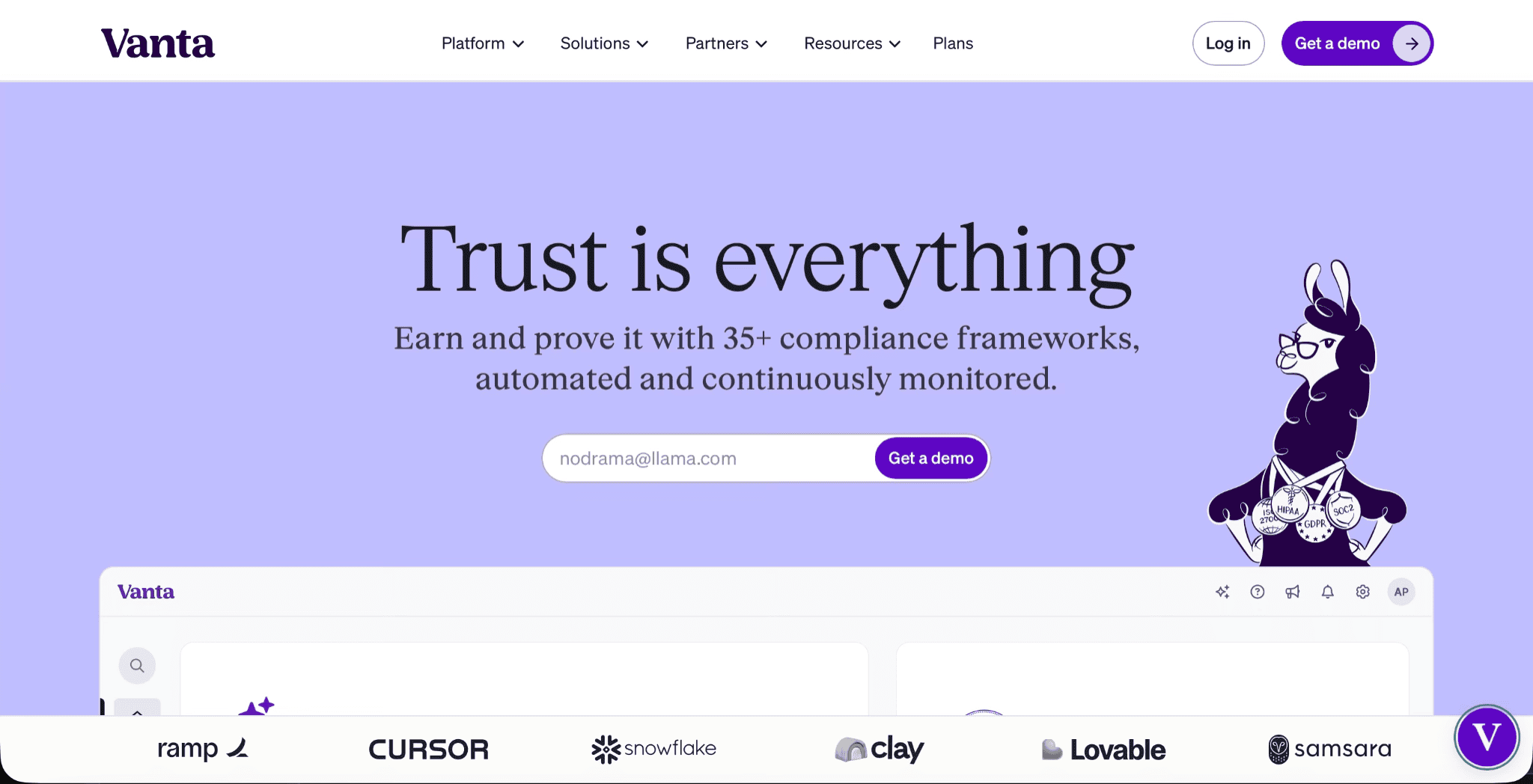
Vanta is built around continuous compliance, risk management, third-party risk, audits, and trust management.
Its AI capabilities extend these workflows rather than operating as a separate AI governance product.
The Vanta AI Agent can assist with policy management and evidence evaluation, while the platform also provides AI-powered questionnaires and compliance workflows.
Another significant consideration Vanta makes towards regulated teams is that its AI capabilities can be turned on or off by administrators, and Vanta cautions that AI-generated outputs will include errors and recommended verification.
This human-review aspect is relevant when compliance evidence might eventually be shown to auditors, customers, or regulators.
What to check: Ask how AI-generated evidence, policy changes, and recommendations are reviewed and recorded before they become part of the compliance program.
2. Drata
Best for: Companies managing multiple compliance frameworks while expanding their AI use.
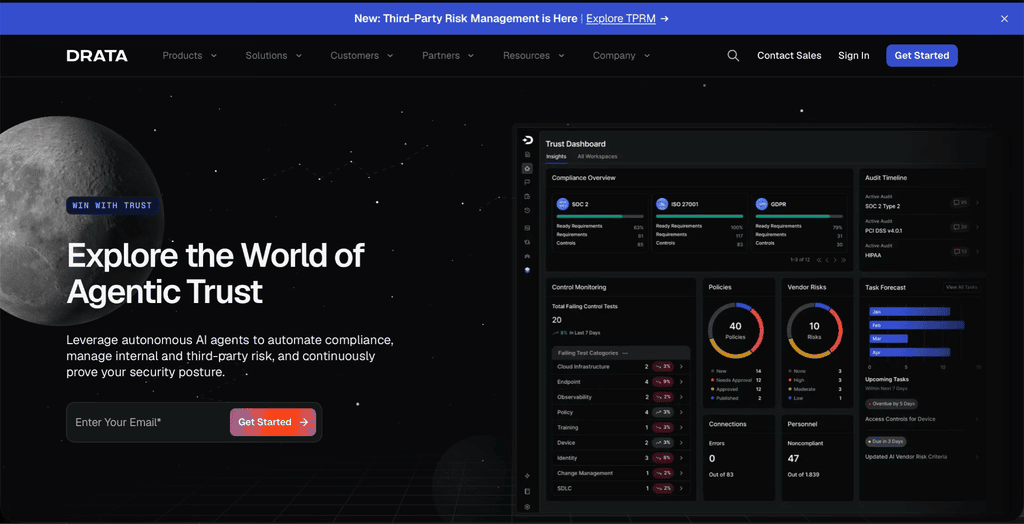
Drata combines compliance automation, risk management, and assurance workflows.
Its AI capabilities are designed to reduce repetitive work across compliance programs while maintaining governance and control.
One notable feature is AI Agent Governance.
Drata says its platform can discover AI agents operating within an environment, enforce policies before actions occur, and generate audit-ready evidence around decisions.
That makes Drata relevant for organizations whose compliance challenge is expanding beyond traditional security controls into the governance of AI agents themselves.
What to check: Find out how the AI agents are recognized by the platform and how policy enforcement is performed when an agent tries to make some restricted action.
3. OneTrust
Best for: Extensive organizations requiring AI governance with privacy and security and wider trust programs.
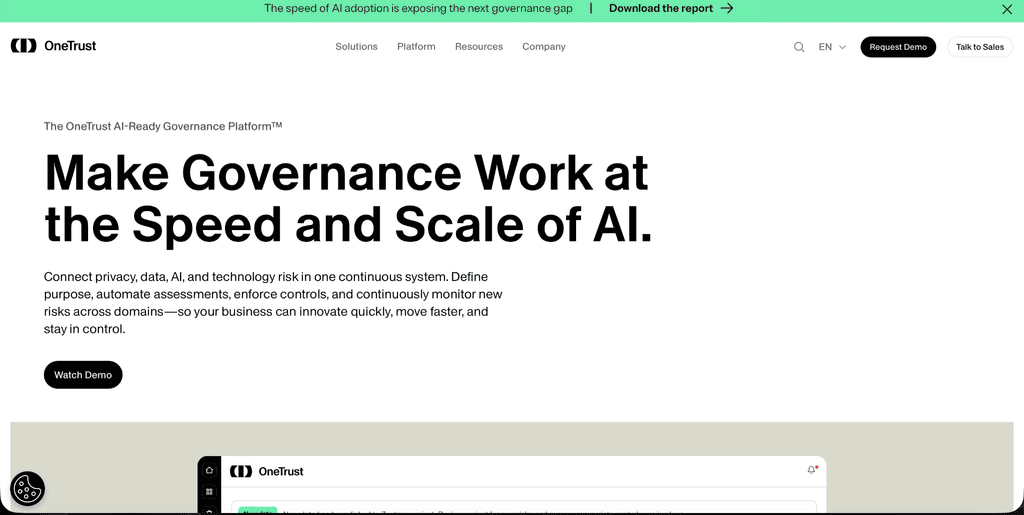
OneTrust approaches AI compliance as a governance problem.
Its AI Governance platform can inventory AI systems, models, agents, datasets, vendors, and use cases.
Organizations can then assess risk, assign ownership, map controls, and establish approval workflows.
The platform also supports frameworks, including the NIST AI Risk Management Framework and ISO 42001.
It has newer runtime facilities that governance into production by observing AI behavior and enforcing policy-based controls.
This broader strategy can be applied in the case of regulated organizations when AI governance intersects with the privacy, data protection, third-party risk, and security needs.
What to check: Determine whether OneTrust can integrate AI inventories and risk assessment with your privacy and GRC programs and does not generate possible duplicate work.
4. Credo AI
Best for: Enterprises that need a dedicated AI governance program across models, applications, and AI agents.
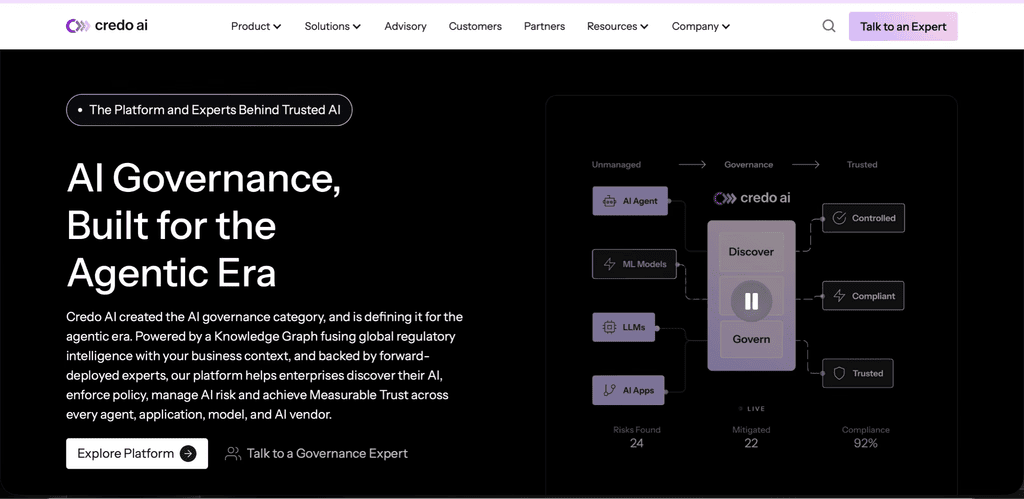
Credo AI is purpose-built around AI governance rather than traditional security compliance.
Its platform provides an AI registry, risk management, policy controls, regulatory mapping, monitoring, and audit evidence.
The platform promotes governance over such frameworks and standards as the EU AI Act, NIST AI RMF, and ISO 42001.
It also incorporates policy workflows and policy packs that are designed to deliver regulatory requirements in operational controls.
This is an important distinction. Even when a company already has a traditional GRC platform, it might still require a specific layer to know which AI systems it has, what they do, what risks they present, and what controls are.
What to check: Test how the platform classifies AI systems and maps different requirements based on the system’s actual use case.
5. Hyperproof
Best for: GRC and compliance teams managing multiple frameworks, controls, evidence, and remediation activities.
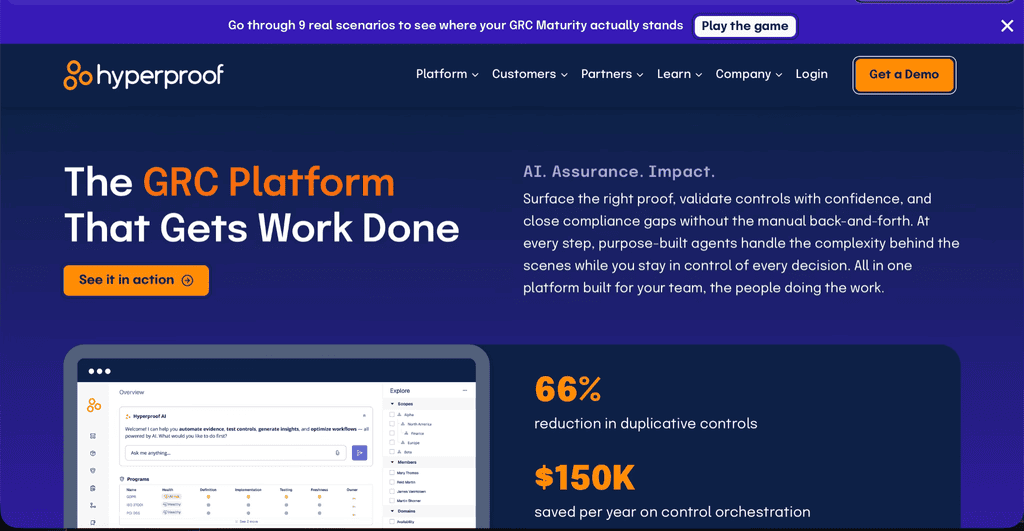
Hyperproof has made AI a part of its compliance processes. Its existing AI includes four domains that include discover, validation, advisory, and action.
These are useful in assisting the teams in finding the pertinent evidence, identifying gaps, and managing follow-ups.
The practical value is not necessarily to substitute a compliance professional, but rather to save time on the information search and the routine administrative activities.
It may be especially handy in case the compliance teams work with multiple frameworks at the time and require a single source of information about risks, evidence, and control status.
What to check: Give the platform a sample control-testing workflow and see whether its AI recommendations can be independently verified before being accepted.
6. Workiva
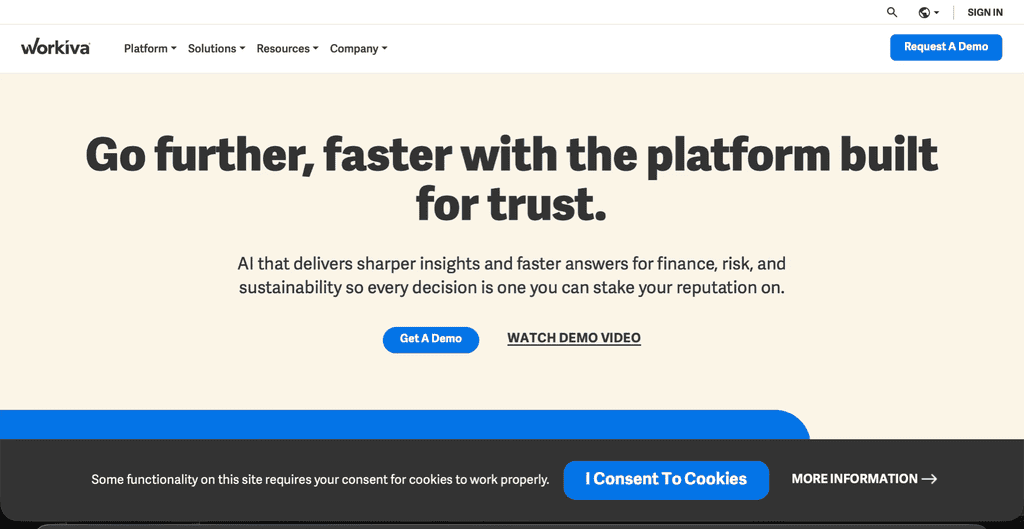
Best for: Enterprise teams connecting compliance, audit, risk, controls, and reporting.
Workiva has a broader enterprise approach to compliance.
Its 2026 platform updates outline AI-driven functionality throughout audit, risk, and controls and GRC workflows, such as evidence ingestion and validation, and AI-enhanced risk insights.
This particularly applies to those organizations in which compliance is not an isolated operation.
Connected data and evidence can be relied on to provide financial reporting, internal controls, audit, risk management, sustainability, and regulatory reporting.
Workiva also mentions that its AI strategy involves human review and that customer information is not utilized to train or tune the giant language models utilized by Workiva AI.
What to check: Explore the flow of AI-generated findings into the current control, audit, and reporting processes and the elements that need human endorsement.
How to Choose AI Tools for Compliance
The easiest mistake is choosing a platform because its AI feature list looks impressive.
Instead, start with the compliance workflow you are actually trying to improve.
Is the biggest problem evidence collection?
AI inventory?
Regulatory change?
Control testing?
Audit preparation?
Third-party risk?
Or monitoring AI systems in production?
Then test the shortlisted platforms against real scenarios.
For regulated organizations, also examine:
- Auditability: Could you rebuild what transpired and why?
- Human control: Are employees able to review, approve, reject or override AI-driven recommendations?
- Data protection: What is the location of compliance data?
- Framework coverage: Is the platform compliant with the standards and regulations in your industry?
- Integration: Does it integrate with your existing identity, cloud, security, GRC, and reporting systems?
- AI governance: Can the organization monitor AI systems, risks, owners, policies, and controls in case the organization utilizes AI internally?
Final Thoughts
AI compliance is taking a new dimension beyond mere automation.
The current compliance tools with AI support can assist teams to gather evidence, enforce hazards, handle controls, administer AI systems, and audit preparedness.
However, accountability is not eliminated due to automation.
The best implementation begins with a well-thought-out compliance process, human control in place, and measurable controls.
Be it Vanta, Drata, OneTrust, Credo AI, Hyperproof or Workiva, run each platform through your real regulatory processes as opposed to referring to a vendor demonstration.
For regulated organizations, the real question is not simply “How much compliance work can AI automate?” It is “Can we demonstrate that the automation itself is governed, controlled, and auditable?”